

As the Happy Mondays hit the road with The Farm, Matt Jacobson interviews Shaun Ryder and Peter Hooton on the past, the tour, and Tesco bags.
More than thirty years after Pills ’n’ Thrills and Bellyaches exploded into the British music landscape, Shaun Ryder remains one of the most distinctive voices the country has ever produced — part poet, part chaos conductor, part accidental philosopher. His lyrics, stitched together from overheard conversations, TV snippets, club culture and pure instinct, helped define an era where anything felt possible and nothing was off‑limits.
Now, as the Happy Mondays gear up for another major tour, I met with Shaun Ryder and Peter Hooton to look back at the music and the moments that somehow turned into history.
What follows is a conversation about ambition disguised as anarchy, the strange economics of modern streaming, the nerves that never quite go away, and the accidental anthems that still echo across dancefloors decades later.
Shaun, how are you feeling — and when you look back at the Pills ’n’ Thrills era, what comes to mind?
Ryder: Back then, we knew we needed a proper hit. You could be number one in the indie charts and sell about 15 copies — brilliant for bragging rights, useless for paying the bills. We wanted something bigger, something that would actually get us on the radio instead of just on a mate’s mixtape. People think it was all chaos, but honestly, we were chasing a tune that would stick.
What changed with that album?
Ryder: Paul Oakenfold changed everything. Him and Steve Osborne sharpened the whole sound. Oakey would drop a beat, and I’d write to it straight away — sometimes the lyrics were done in minutes. It matched the club culture we were living in. It felt modern, like we’d plugged the Mondays straight into the dancefloor.
Hooton: That beat‑first approach was unusual for guitar bands then. Now it’s standard — rhythm first, everything else after.
The lyrics from that era are iconic. Where did they come from?
Ryder: Everywhere. Kinky Afro was basically ten ideas colliding in my head — bits of conversation, stuff off the telly, whatever nonsense was floating around. The “Yippee‑aye‑aye” came from Die Hard. We’d just watched it, it stuck, so in it went.
God’s Cop was about James Anderton — he wanted raves shut down, yet his daughter was always at The Haçienda. You couldn’t script it better.
Loose Fit wasn’t about baggy jeans — it was about that chilled‑out vibe while the Gulf War was on the news every night. Lyrics come from everywhere — the news, the soaps, the streets. And sometimes we just wanted to wind people up. Keeps life interesting.
With Step On, once Oakey put his beat on it, it became ours. “You’re twisting my melon, man” came from a documentary about Steve McQueen. “Call the cops!” was this fella who used to shout it round The Haçienda. Real life writes the best lines.
Hooton: I used to scribble down conversations in the pub — hundreds of beer mats and scraps of paper stuffed in a Tesco bag. I still have them somewhere
Ryder: I still do that. I’ve got some here! I’ve had an autocue for 20 years — can’t remember lyrics, but I can remember daft quotes from 1978.
The songs have been streamed tens of millions of times. That must feel good?
Ryder: It’s great people are still listening. But let’s be honest — 50 million streams earns you about 17 quid. Streaming looks impressive on paper, but it’s not paying the bills. Touring is where musicians survive now. That’s where it’s real — you see the crowd, you feel the energy, and that’s what keeps you going.
Hooton: TikTok’s changed things again. People with millions of followers can blow a track up overnight. Rap stars seem to be the ones shining on there at the moment.
How has the industry changed overall?
Hooton: In terms of technology, really. When we started, it was guitars in a studio. Then the late ’80s hit — sampling, remix culture, experimentation. It felt like anything was possible.
Ryder: Now you can make a record in your bedroom. Brilliant, really. Just don’t expect it to buy you a mansion off streams. 50 million streams makes you about 17 quid – whoever did that streaming deal wants their nose biting off
Hooton: Touring is now where musicians survive.
Do you still get nervous before going on stage?
Ryder: Yeah. Anyone who says they don’t is lying.
Hooton: I used to get so nervous I’d vomit before gigs. People thought I was off me head — half the time it was just adrenaline and whatever lasagne I’d had before. I don’t eat before shows now. And on tour we had a full team of around 30 people — I was nervous about keeping the whole thing running and keeping people in jobs.
Ryder: But once you step out there, it’s magic. That buzz never leaves you.
And excited to play Liverpool?
Hooton: Always special. Different energy. Your mates are there, the guest list is enormous, and the crowd’s got that spark.
Ryder: I’ve been going to Liverpool for years. Got friends and bandmates there. Always a great place to play — proper atmosphere.
The tour is huge — is there a chance you could forget what city you’re in?
Ryder (laughs): I don’t know where I am most of the time. I just go where the bus takes me.
Thanks for your time — and best of luck with the tour.
Hooton: Matt, this tour could be interesting.
Don’t forget your Tesco bag and lyrics, Peter.
Ryder: Thanks mate — see you at the gig.
Hooton: Thanks Matt, appreciated.
Thirty‑five years on from Pills ’n’ Thrills and Bellyaches, Shaun Ryder isn’t chasing chaos — he’s reflecting on it. The myth of the Happy Mondays may be drenched in excess, but beneath it was ambition, instinct, and an ear tuned to the pulse of a generation.
From lyrics scribbled in minutes to accidental anthems that still fill dancefloors, the legacy endures. The industry has shifted, streaming dominates, and the touring circuit blurs into one long motorway — but the thrill of stepping on stage remains unchanged.
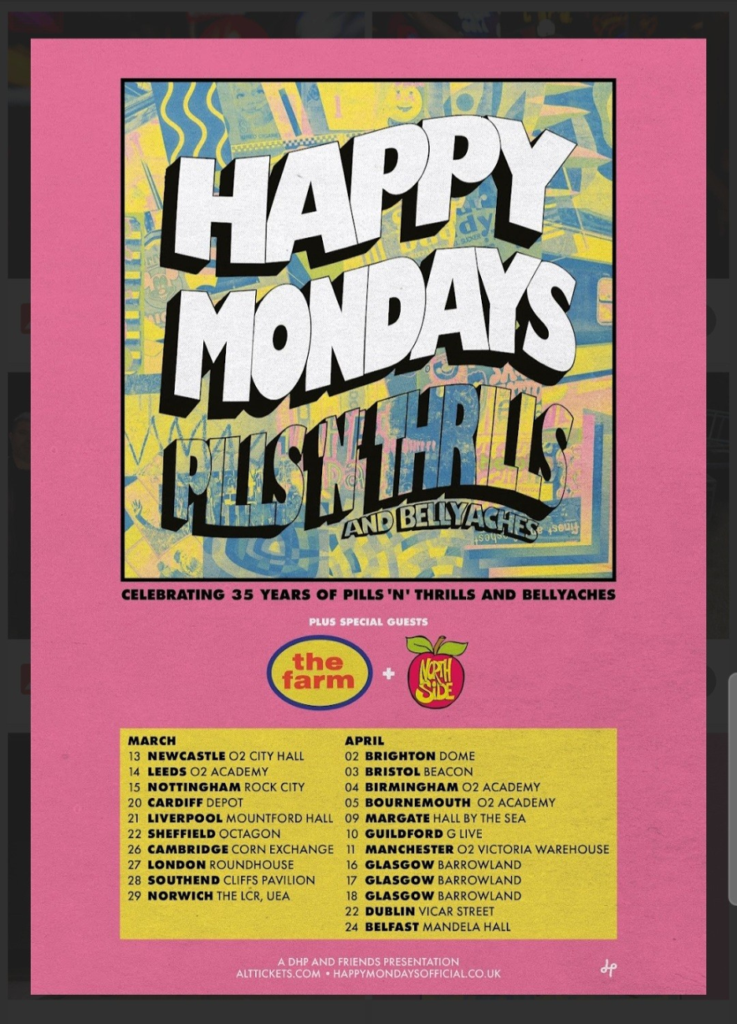
Happy Mondays fans have plenty to look forward to this year, with the band performing 22 dates across March and April, including stops in London, Nottingham, Cardiff, Newcastle, and their home city of Manchester.
With thanks to Shaun, Peter, and Warren.
Matt
Matt Jacobson
Explore Liverpool
READ MORE: Matthew Jacobson interviews Dave Hill on Slade’s Final Tour