

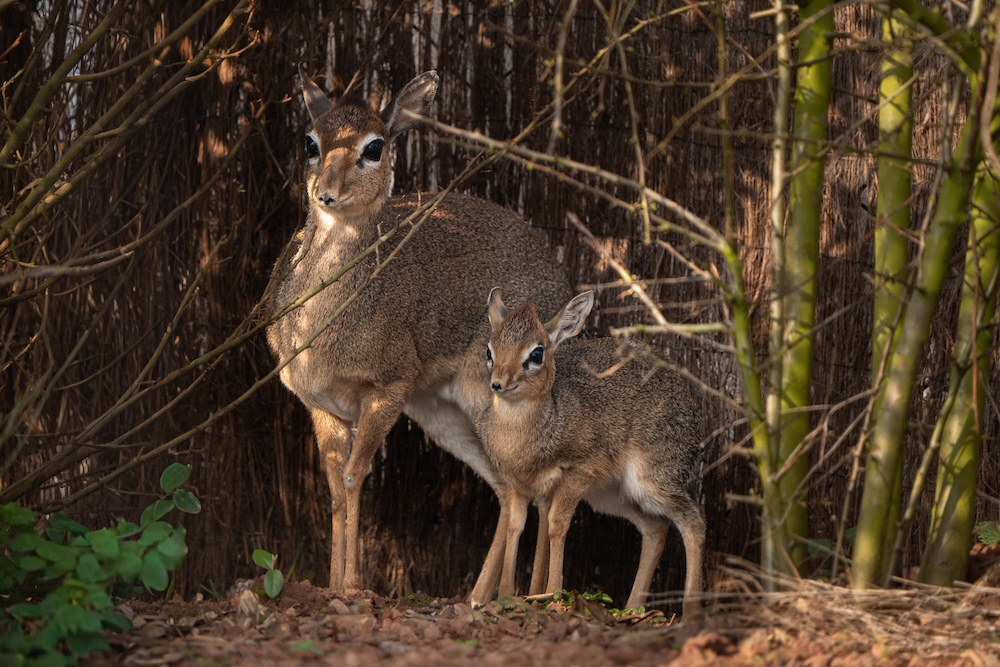
One of the world’s smallest baby antelopes has taken her first wobbly steps at Chester Zoo, standing barely taller than a tin of baked beans.
The tiny Kirk’s dik-dik fawn, named Dotty, was born on Tuesday, 17 February 2026, weighing just a few hundred grams.
When fully grown, she will reach just 40cm tall, making her one of the smallest antelopes on the planet.
In a heartwarming twist, Dotty is being raised with the help of a surrogate father; while her biological dad passed away of old age shortly before her birth, a new male dik-dik named Dan, who arrived from a zoo in Cumbria in February, has gently stepped into the role alongside mum Chrissy.
Kirk’s dik-dik are one of the world’s smallest species of antelope, often found in the scrublands and mountainous regions of Kenya, Tanzania, and Namibia.
They take their name from the sharp, high-pitched “dik-dik” alarm call they make when startled and as they dart for cover.
Conservation Success and Family Bonds
The birth is a significant moment for the zoo’s small mammal team and the wider European conservation breeding programme.
Megan Carpenter, Assistant Team Manager of Small Mammals at Chester Zoo, said:
“Dik-diks are naturally very shy animals, so for the first couple of weeks Chrissy’s tiny fawn has been tucked away in a quiet, cosy den, with mum popping back to feed and check on her.
“Now though, she’s beginning to find her feet and we’re seeing those lovely first steps as she heads out on her first little outdoor adventures.
“In a lovely addition to the story, we’ve also welcomed a new male dik-dik, Dan, as part of the European conservation breeding programme.
“He’s already stepped in alongside mum Chrissy to help raise the newborn and it’s wonderful to see the three of them together.”
Unique Features of the Kirk’s Dik-Dik
Beyond their diminutive size, these antelopes possess several fascinating biological traits that help them survive in the African scrublands.
They use elongated, flexible noses to pluck leaves directly from branches, a unique feature found only in dik-diks.
Furthermore, they are known for their territorial nature, marking their space using scent glands located beneath their eyes and between their toes.
As Dotty continues to grow and explore her habitat, she serves as a tiny but mighty ambassador for her species.
Visitors to Chester Zoo may now be able to spot the youngster as she gains confidence and begins her outdoor adventures alongside Chrissy and Dan.