
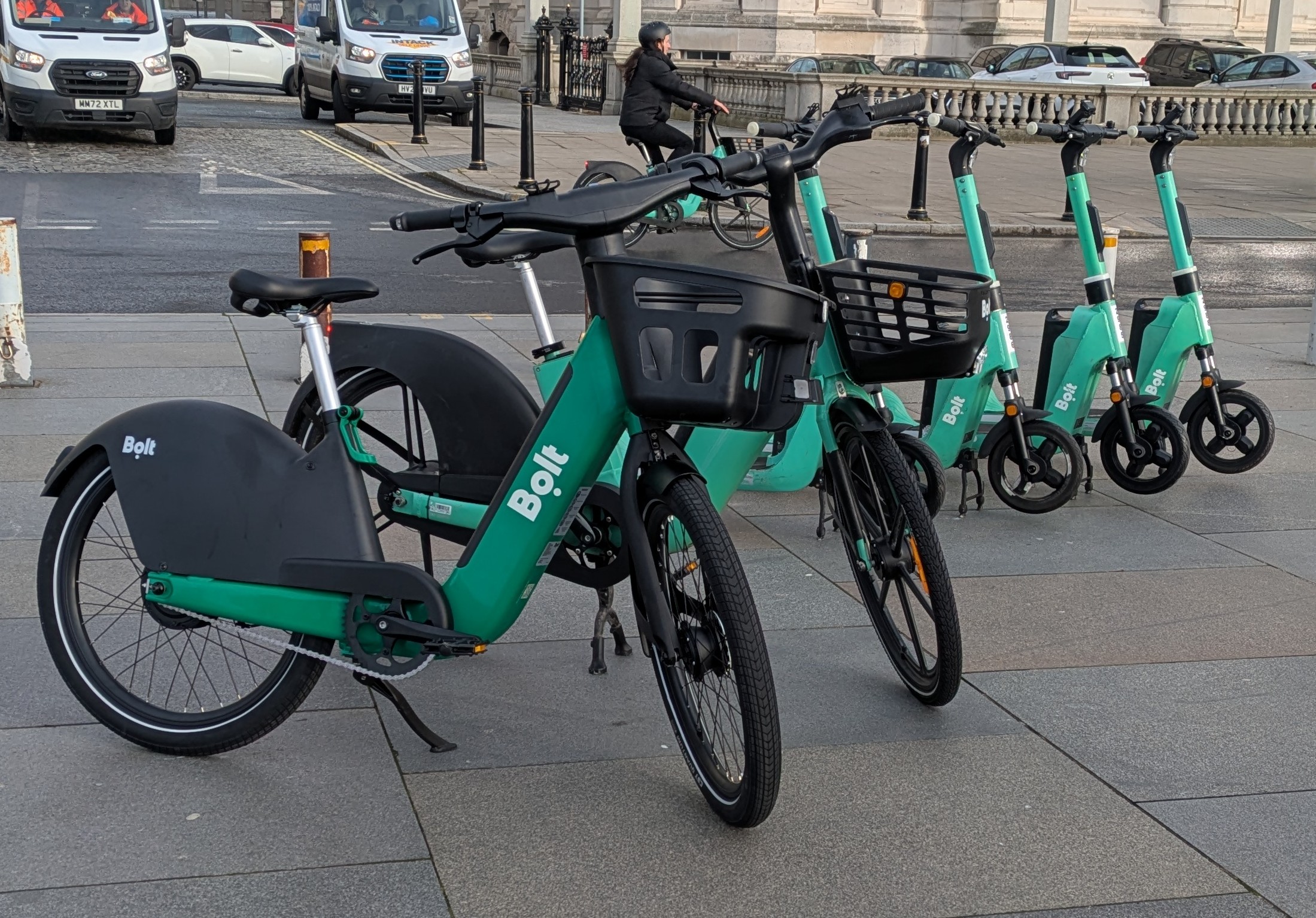
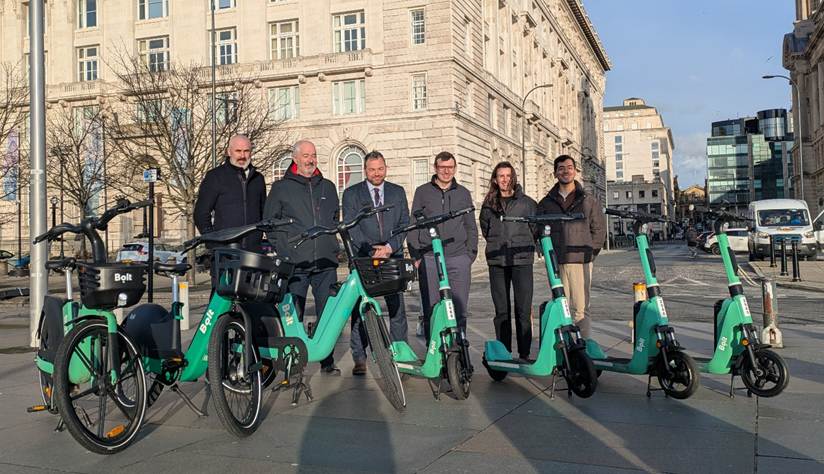
Bolt, working in partnership with Liverpool City Council and Liverpool City Region Combined Authority, will launch a new shared micromobility service in Liverpool from Sunday 1 February, replacing existing provider Voi.
The launch will see 2,000 electric scooters and 150 e-bikes introduced across the city, operating 24 hours a day, seven days a week. Coverage will extend city-wide, with neighbourhoods including Speke and Garston gaining access to shared e-scooters for the first time.
Expanding Liverpool’s e-scooter and e-bike offer forms part of the Council’s wider ambition to encourage active and sustainable travel. Almost two-thirds of all journeys in the city are currently made by car, contributing close to half a million tonnes of CO₂ emissions each year. Shared micromobility offers a cleaner alternative, helping to cut congestion during peak travel times while supporting healthier travel choices.
As part of the rollout, Bolt will introduce a distance-based pricing option, allowing riders to pay per mile rather than per minute. The approach is designed to encourage safer, more considerate riding by removing incentives to rush journeys, take risks at busy junctions or park incorrectly to reduce costs.

The e-scooters will feature industry-leading safety and parking technology, including capped speed limits, AI-powered photo validation to ensure correct parking, and a built-in test to prevent riding under the influence.
In the coming weeks, Bolt will also begin a phased rollout of a new generation of shared e-bikes, with Liverpool selected as the first city in the UK to receive Bolt’s solar-assisted e-bikes. Each bike is fitted with an integrated solar panel to extend battery life and improve availability.
The solar technology is expected to save up to 3.7 kWh of energy per bike per year, equivalent to avoiding more than six battery swaps annually. The e-bikes will also feature regenerative braking, converting braking energy into electricity to further power the bike.
New UK research commissioned by Bolt highlights the role shared micromobility can play in connecting people to public transport, revealing that four in ten e-bike users travel to train stations or transport hubs, while more than a third use e-bikes to commute to work.
The Liverpool launch follows Bolt’s successful e-bike rollout in London in 2025 and underlines the company’s continued investment in sustainable urban transport across the UK.
Councillor Dan Barrington, Liverpool City Council’s Cabinet Member for Transport and Connectivity said:
“We know that e-scooters are incredibly well used across Liverpool, and they provide a quick, sustainable way to travel throughout the city. We’re looking forward to welcoming Bolt into the area.
“I’m pleased to see the number of measures in place to promote safe, responsible use of their e-scooters and e-bikes. The new service will operate at all hours of the day and cover more areas than ever before, giving additional support for people working late at night when there is no public transport.”
Councillor Steve Foulkes, Chair of the Transport Committee at Liverpool City Region Combined Authority said:
“Building on more than five years of our successful e-scooter scheme, this new partnership with Bolt marks the next chapter in our commitment to delivering a truly integrated transport network that’s greener and easier to use.
“In expanding services, we’re ensuring that micro-mobility is no longer just confined to the city centre, but a practical, daily tool for residents in neighbourhoods across Liverpool.
“Working with Bolt and Liverpool City Council we’re taking a further step to embed e-scooters and e-bikes into the region’s travel offer, providing a genuine alternative to the car that supports our climate goals while keeping people moving safely and efficiently.”
Georgia Heathman, Bolt’s UK Policy Lead, said:
“Liverpool is a city with huge potential for shared, sustainable transport. By expanding scooters and e-bikes across the entire city, introducing distance-based pricing, and rolling out our most advanced e-bikes to date, we’re making it much easier for people to get around while also reducing car traffic.”
READ MORE: Liverpool City Region to host the 2027 Tour de France